Solutions Ecosystems Reports Resources Data Pricing Login Book a demo
Valuation & exit multiples — private companies

What private companies are actually worth

EV / Revenue across 4,500+ private-company exit and VC deals, 2015–2026.

02 · Segments

Where the multiple lands

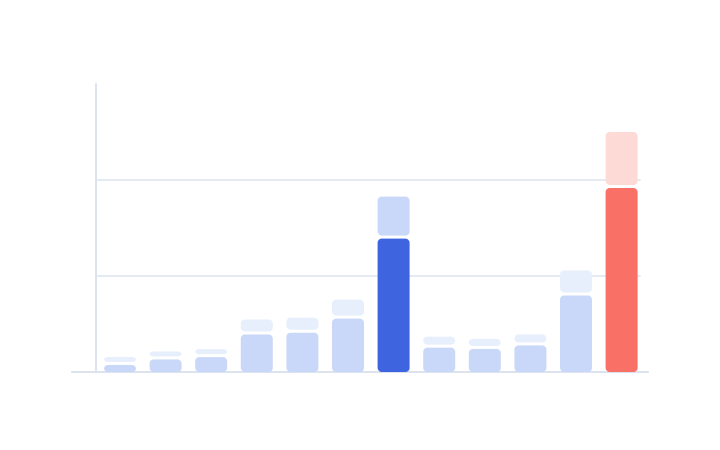
Median EV / Revenue by revenue growth, deal size, geography and sector.
Location
Sector
Exit rounds
VC rounds

Baseline cut: founded 1990+, $5M+ peak revenue, EV/Revenue ≤ 300×, "Outside Tech"-tagged rows excluded.

03 · Historical multiples

How the multiple moves with the cycle

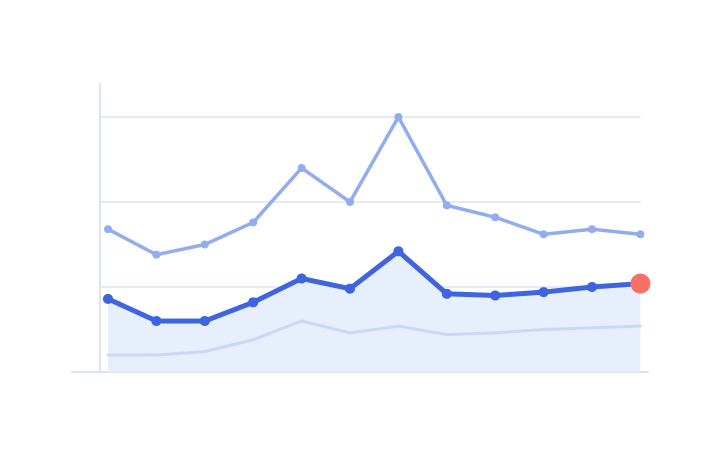
Bottom quartile, median and top quartile per year. The shaded band is the inter-quartile range.

VC basis
View
Bottom quartile Median Top quartile
Exit rounds
VC rounds

By region

North America, Europe and Asia. Toggle median vs top quartile.

Exit rounds by region
2015–2026
VC rounds by region
2015–2026

AI vs non-AI

AI-tagged companies vs everything else. The premium opened up post-2020.

Exit rounds: AI vs non-AI
2015–2026
VC rounds: AI vs non-AI
2015–2026

Bay Area vs Rest of US

US-only universe, split by Bay Area HQ vs the rest of the US.

Exit rounds: Bay Area vs Rest of US
2015–2026
VC rounds: Bay Area vs Rest of US
2015–2026

By round stage

Median pre-money EV / Revenue at funding, by stage.

Median EV / Revenue at funding, by stage
04 · Public companies

And on the public side

Private rounds and exits are only half the picture. Here's how the public-market comp set is pricing the same tech themes today — median EV / Revenue (next-twelve-month) across ~7,000 publicly traded companies.

As of today

Public multiples by theme

Monthly median EV / Revenue (NTM) across the public-comp baskets for each tech theme. Click pills to add or remove themes — the Non-tech pill overlays a broader-market reference line.

Median EV / Revenue (NTM) by tech theme — last 3 years
Click a theme to add or remove it from the chart. Each line is the monthly median EV / Revenue (next-twelve-month) for the public-market basket in that theme.
Source: multiples.vc · underlying data from FactSet (analyst consensus) and Morningstar (historicals)

Public multiples by region

Same metric, sliced by HQ geography. Bay Area is a curated set of SF Bay Area HQ tickers (the API has no city filter). The toggle switches between tech-themed companies only and all listed companies in each region.

Median EV / Revenue (NTM) by region — last 3 years
Same metric, sliced by HQ geography. Click a region to add or remove it. The toggle switches between tech-themed companies only (default) and all listed companies in that region. Bay Area is a curated SF Bay Area HQ set (the API has no city filter); the Non-tech line aggregates banks, energy, utilities, real estate, industrials and other non-tech sectors.
Source: multiples.vc · medians computed across top tickers by enterprise value per region (Bay Area is a hand-curated list)

Rule of X

The Rule of 40 — popularised by Bessemer Venture Partners — sums revenue growth + EBITDA margin to flag healthy software companies (40% is the bar). Rule of X generalises it: X · growth + margin. At X = 3 growth is worth 3× margin — the premium public markets pay for durable top-line expansion. Plotting it against EV / Revenue surfaces who's pricing above and below the trend.

Tech revenue multiples — Rule of X (with X = 3)
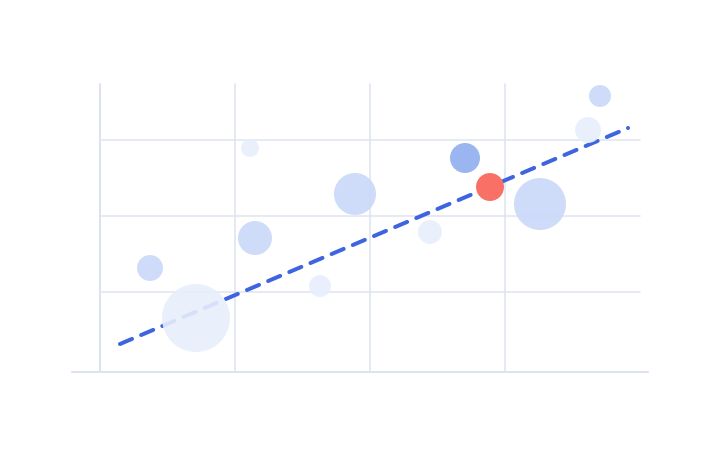
Each bubble is one publicly traded tech company. Larger bubbles = larger enterprise value. The dashed trend line is the OLS regression across the visible basket.
Sector
Business model
Rule of X = 3 × revenue 2-yr CAGR + EBITDA margin (LTM). Y-axis: EV / Revenue (NTM). Bubble size: enterprise value. Dealroom analysis with multiples.vc data · refreshed today

The SaaSpocalypse — and the slow road back

An equal-weighted basket of public SaaS stocks tripled from Jan 2020 to Oct 2021, then gave back ~60% by the December 2022 trough. The recovery has been long and uneven: another peak in October 2025, then a fresh leg lower into Q1 2026. Recent SaaS IPOs face their own correction inside the same regime — Figma debuted at $115.50 in August 2025 and trades around $18 today (−85%); Klaviyo is down 50% from IPO.

Recent share-price moves vs X sentiment
Each bubble is a selected public SaaS or AI software company. X-axis is the selected share-price window from multiples.vc; Y-axis is live X sentiment pulled from the same AI-synthesized company-profile module. Bubble size reflects public market value.
Share prices are monthly and use the latest available point; bubble size uses enterprise value as the public market-value proxy. Dealroom analysis with multiples.vc data and company-profile X sentiment
And the same story in valuation multiples — median EV / Revenue (NTM) by theme
Each line is the monthly median EV / NTM revenue multiple across that theme's public-company basket. Core SaaS multiples peaked Aug 2021 at ~4.8×, troughed Dec 2022 at ~2.5×, and have re-compressed into Q1 2026 as revenue grew faster than share prices.
Multiples = EV / NTM revenue, monthly median per theme. Counts are shown in the pills. Theme examples:
Horizontal SaaS: Salesforce, ServiceNow, Workday, Atlassian.
B2B SaaS: Snowflake, Datadog, MongoDB, HubSpot, Cloudflare.
Vertical SaaS: Toast, Procore, Veeva, nCino, Bentley.
Generative AI: Palantir, AppLovin, C3.ai, SoundHound AI.
Consumer SaaS: Shopify, Wix, Roblox, Reddit.
Dealroom analysis with multiples.vc data · refreshed today
See public + private multiples side-by-side

Dealroom plugs the public-comp universe directly into the private-company data we already track — one workspace for every benchmark you need. Live tickers, forward analyst estimates and 4M+ private companies.

Live data licensed from multiples.vc, which sources analyst consensus from FactSet and historicals from Morningstar. Figures refresh on each build of this page.

05 · Methodology

How the numbers come together

One row per deal, from the Dealroom Multiples sheet.

Key facts

  • 4,581 private-company deals in the current public cut
  • 1,589 exit rounds and 2,992 VC rounds
  • Coverage spans 2015-2026 globally
  • Primary metric: EV / Revenue at exit or funding
  • Segment cuts include growth, deal size, geography, sector, AI, Bay Area and funding stage

The multiple

Exit rounds use EV / Revenue at exit. VC rounds default to post-money EV / Revenue, with a toggle for pre-money. Quartiles are computed nearest-rank on the sorted list of multiples — no interpolation, so each quartile sits on a real deal.

Baseline filters

  • Founded 1990 or later
  • $5M+ peak revenue in the sheet's revenue history
  • EV / Revenue ≤ 300×
  • Tagged "Outside Tech" rows excluded

Bucketing

Revenue growth is computed as the latest non-null year over the previous non-null year in the revenue history. Deal size is the round_amount_usd at the time of the deal. Geography uses the company's HQ continent / country. Buckets with fewer than 3 deals are dropped from segment charts to keep medians honest.

Source

The Dealroom Multiples & Valuations source dataset has one row per deal and is refreshed regularly from the Dealroom database. Run node scripts/build-multiples-data.mjs to regenerate this page's data.

Outliers

Multiples above 2,500× are dropped at the parser stage — they're almost always pre-money valuations that leaked into the multiple column. The page-level 300× cap drops the remainder of the long tail so quartiles aren't skewed by a single blow-up.

Track multiples across your portfolio

Dealroom's platform tracks EV / Revenue, ARR and revenue trajectories across 4M+ private companies. Use it to benchmark portfolio companies, pre-empt valuation conversations, and find the right comps.